It was first called the “Great War”—a name that reflected its unprecedented global scale and the staggering destruction it left in its wake. The phrase “War to End All Wars” captured the desperate hope that a conflict so massive and so terrible could never be repeated. That hope proved unfounded. In the eighty-three weeks of direct American involvement, 116,516 service members died in what the world would later call World War One.
Before the United States declared war on Germany in April 1917, President Woodrow Wilson held firmly to a policy of neutrality. His 1916 reelection slogan—“He Kept Us Out of the War”—spoke to his conviction that American troops should not fight on foreign soil. But Germany would push Wilson to his limits, and his commitment to neutrality ultimately gave way. Two events would make that outcome inevitable.
The first was Germany’s campaign of unrestricted submarine warfare. German U-boats sank American merchant ships without warning, and in May 1915, the destruction of the British ocean liner RMS Lusitania—killing 128 Americans—began to erode public support for staying out of the war. The second blow came in early 1917, when British cryptographers intercepted and decoded a secret telegram from German Foreign Minister Arthur Zimmermann to the German ambassador in Mexico. In it, Zimmermann proposed that if the United States entered the war, Germany would help Mexico reclaim Texas, New Mexico, and Arizona. When the contents became public, American outrage was swift and decisive. On April 6, 1917, President Wilson asked Congress for a declaration of war against Germany. Both houses approved with overwhelming support, and America marched off to war.
On the battlefields of Europe, American soldiers—known as Doughboys—encountered conditions that shocked even hardened veterans. Much of the fighting took place in trenches: six- to seven-foot-deep channels that offered some protection from artillery and machine-gun fire but little else. When the rains came, the trenches flooded, and men stood in water long enough to develop trench foot, a painful condition that sometimes required amputation. Rats thrived in the filth, feeding on food scraps, human waste, and the dead. Disease followed. And when the order came to go “over the top” and cross No Man’s Land—the open ground between opposing trenches—soldiers faced machine guns and artillery with little cover and almost no chance.
The war introduced weapons capable of killing on an industrial scale: the machine gun, high-explosive artillery, tanks, and the flamethrower. But none struck more fear than poison gas. Germany was the first to deploy it on the battlefield. Chlorine and mustard gas caused men to choke violently, blistered exposed skin, and could destroy eyesight permanently. Soldiers who couldn’t get their gas masks on in time faced a slow and agonizing death. There seemed to be no limit to the means by which men would destroy one another.
On the home front, the sinking of American ships and the revelation of the Zimmermann Telegram transformed public opinion. Citizens rallied behind the war effort. Some twenty million Americans purchased Liberty Bonds to help finance it; those who couldn’t afford bonds bought War Savings Stamps. Rationing became part of daily life—“Meatless Mondays” and “Wheatless Wednesdays” were common sacrifice. Patriotic songs like “Goodbye Broadway, Hello France,” “Let’s All Be Americans Now,” and the enormously popular “Over There” filled theater halls and family parlors. With millions of men overseas, women entered the workforce in record numbers, building the weapons their husbands, brothers, and sons would carry into battle.
In 1917, the Service Flag made its first appearance. Displayed in the front windows of homes across the country, the flag bore a blue star for each family member serving in the armed forces. In McHenry County, those flags could be seen in countless windows. When a service member was killed, a gold star was stitched over the blue. Before the Armistice was signed on November 11, 1918, the citizens of McHenry County had mourned the loss of 54 men. Among them were sixteen-year-old Army Private Richard Japp of Woodstock and Distinguished Service Cross recipient Marine Second Lieutenant William Peterson of Crystal Lake.
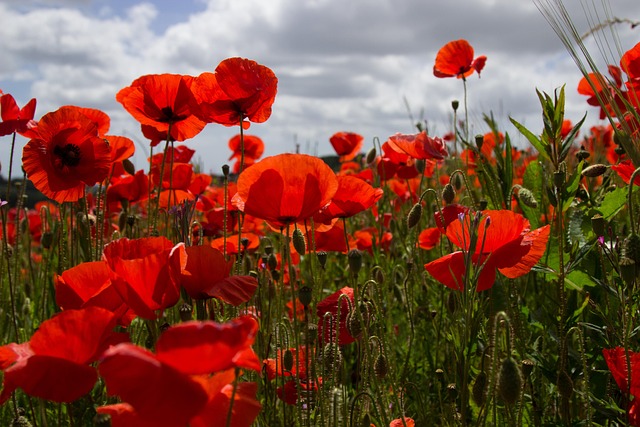
On Memorial Day, the red poppy is worn to honor those who died in World War One. In the war-ravaged landscape of northern France and Belgium, red poppies were among the first flowers to bloom across the shattered earth. In 1920, the red poppy became the national emblem of remembrance and the official flower of the American Legion.
In 1915, Canadian physician and soldier John McCrae wrote the poem “In Flanders Fields.” Inspired by the sight of bright red poppies blooming across the battle-scarred landscape, he composed a tribute to the fallen that has endured for more than a century.
“In Flanders Fields”
In Flanders fields the poppies blow
Between the crosses, row on row,
That mark our place; and in the sky
The larks, still bravely singing, fly
Scarce heard amid the guns below.
We are the Dead. Short days ago
We lived, felt dawn, saw sunset glow,
Loved and were loved, and now we lie
In Flanders fields.
Take up our quarrel with the foe:
To you from failing hands we throw
The torch; be yours to hold it high.
If ye break faith with us who die
We shall not sleep, though poppies grow
In Flanders fields.